 Bradenton
 Two Sidings, Two Different Starting Materials
Homeowners in Bradenton comparing siding quotes usually end up looking at two very different products side by side: James Hardie fiber cement and LP SmartSide engineered wood. Both are marketed as durable, low-maintenance alternatives to vinyl and traditional wood, and both have loyal installers around the country. But they are not the same kind of material, and in Manatee County's climate — hurricane-force wind events, wind-driven rain, intense year-round UV, and salt air pushing in off Sarasota Bay and the Gulf — that difference matters more than it does in a drier, milder region.
Fiber cement is a mix of Portland cement, sand, and cellulose fiber, cured into a rigid, non-combustible board. Engineered wood siding like LP SmartSide is built from wood strands and fiber bonded with resins and waxes under heat and pressure, similar in concept to oriented strand board (OSB), then coated with a treatment designed to resist moisture and insects. Both are manufactured products engineered to outperform solid wood — but one is fundamentally a cement product and the other is fundamentally a wood product, and that root difference shapes everything else in this guide.
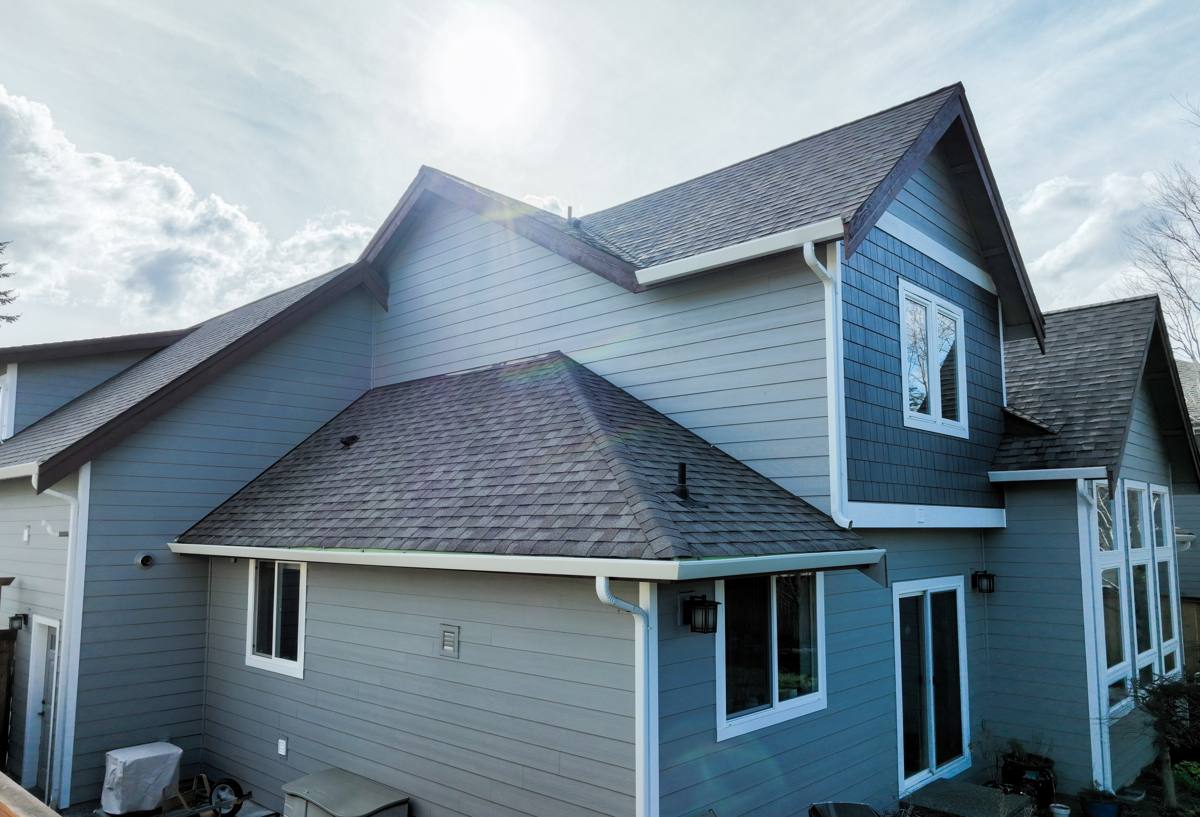
What LP SmartSide Gets Right
It's worth being straightforward about this: LP SmartSide is a legitimate, engineered product, not a discount corner-cutter's material. LP treats its strand and fiber substrate with zinc borate to resist termites and fungal decay, which is a real improvement over the untreated wood siding it was designed to replace. It's lighter than fiber cement, which can make it faster and less physically demanding to install. It accepts paint well, holds a crisp trim profile, and costs less per square foot installed than most fiber cement systems. For homeowners in drier, more moderate climates, or for outbuildings and accent applications, it's a defensible choice, and plenty of installers stand behind it.
We don't install it — but that's a decision about what we're willing to warranty and stand behind on Gulf Coast homes specifically, not a claim that the product is worthless everywhere it's used.
Where Engineered Wood Struggles in a Gulf Coast Climate
Moisture Is the Core Issue
Wood-based products, no matter how well engineered, share one vulnerability: wood swells when it absorbs water and shrinks as it dries. LP SmartSide's resin treatment slows moisture absorption, but it doesn't eliminate it, and the vulnerable point on almost every wood-strand product is the cut edge — where a saw has exposed the raw substrate during installation. In Bradenton's humidity, where afternoon storms are routine much of the year and wind-driven rain during tropical systems can drive water sideways into wall assemblies, every field cut, every butt joint, and every place a fastener splits the surface becomes a spot where the manufacturer's factory treatment no longer applies. If those cut edges aren't field-sealed exactly per the manufacturer's instructions — every time, on every board — moisture finds its way in.
Humidity Cycling and Panel Movement
Manatee County doesn't get a dry season the way a lot of engineered-wood siding was originally tested for. Near-constant humidity followed by intense sun exposure puts wood-based panels through repeated swell-and-shrink cycles. Over years, that cycling stresses seams, caulk joints, and paint film in a way that's more forgiving in a drier climate. Fiber cement, being a cement-based product, doesn't swell and shrink with humidity the same way — it's dimensionally far more stable across Florida's wet-to-dry humidity swings.
Termites and Wood-Boring Insects
Florida is aggressive termite territory, and Manatee County is no exception. LP's zinc borate treatment is a genuine defense, but it is a treatment applied to a wood product — not a wood-free material. Fiber cement contains no cellulose food source at all, which removes the question entirely rather than managing it with a chemical barrier that depends on correct, complete application.
What James Hardie Fiber Cement Brings to a Coastal Home
James Hardie's fiber cement is non-combustible, doesn't provide a food source for termites or carpenter ants, and holds its dimensions across Florida's humidity swings far better than any wood-based product. For coastal and hurricane-belt markets, Hardie makes HZ5 formulations specifically engineered for high-humidity, high-moisture-cycling regions like ours — it's a product line built around exactly the conditions Bradenton sees every year, not a general-purpose board pressed into service here.
Hardie's factory-applied ColorPlus finish is also worth understanding on its own. Instead of relying on field-applied paint (which is only as good as the day it was sprayed and the primer coat under it), ColorPlus is baked on in a controlled factory environment in multiple coats, engineered specifically to resist UV fading — a real consideration in Bradenton, where sun exposure is intense essentially year-round. That finish carries its own dedicated warranty against fading and peeling, separate from the substrate's structural warranty.
Side-by-Side: The Core Differences
| Factor | James Hardie Fiber Cement | LP SmartSide Engineered Wood |
|---|---|---|
| Core material | Portland cement, sand, cellulose fiber | Wood strand/fiber with resin binders |
| Combustibility | Non-combustible | Combustible (wood-based) |
| Moisture behavior | Dimensionally stable; doesn't swell/shrink with humidity | Resists moisture with treatment, but wood substrate can swell if compromised |
| Termite/insect risk | No cellulose food source | Zinc borate treated; still a wood substrate |
| Cut-edge sensitivity | Low; cement doesn't wick like wood | High; every field cut needs proper sealing |
| Finish | Factory-baked ColorPlus, UV-engineered | Factory primer or field paint options |
| Typical weight | Heavier, more rigid | Lighter, easier to handle |
| Installed cost | Higher per square foot | Generally lower per square foot |
Installation Sensitivity: Why the Details Decide the Outcome
Neither product performs to its potential if it's installed carelessly — that's true across the entire siding industry. But the consequences of a shortcut differ by material. Fiber cement that's fastened, gapped, and flashed correctly according to James Hardie's published installation instructions holds up for decades; the failure mode when Hardie is installed wrong is almost always a workmanship issue (wrong fastener pattern, missing flashing, caulked joints that should have been left to breathe) that a qualified crew avoids by following spec.
Engineered wood siding has an added layer of installation risk because the substrate itself is what's being protected. Every cut end needs field-applied sealer before the board goes up. Every joint needs the manufacturer's specified caulk and clearance. Miss one board on a two-story elevation facing prevailing wind-driven rain, and that's the point where moisture gets a foothold — and because it's happening inside a wood-strand panel rather than on the surface of a cement board, it isn't always visible until the damage has already progressed.
What Correct Hardie Installation Actually Involves
- Minimum clearance from grade, roofing, and decks per Hardie's published specs — not "close enough"
- Correct fastener type, spacing, and embedment (blind- or face-nailed per the specific product line)
- Proper flashing at every window, door, and penetration before siding goes on
- Butt joints treated per manufacturer instructions — sealed or flashed, never just butted and caulked over
- Factory-cut edges kept intact wherever possible; field cuts finished per Hardie's edge treatment guidance
- Correct panel gapping to allow for the material's minor thermal movement
Warranty and the Real Cost Over Time
Sticker price on the estimate is only part of the cost story. James Hardie's fiber cement products carry a long, transferable substrate warranty, and the ColorPlus finish carries its own separate finish warranty — both structured around the expectation that the product, installed to spec, isn't expected to need repainting or major repair on a normal homeowner's timeline. LP SmartSide's warranty structure is built around its own treated wood substrate and is worth reading closely, particularly the sections on caulking and finish maintenance requirements, since ongoing maintenance obligations are often a condition of keeping coverage in force.
Over a 15- to 20-year ownership window, the practical cost comparison usually comes down to how much field maintenance a homeowner is willing to keep up with — caulk inspection, repainting cycles, checking cut edges after storms — versus paying more upfront for a factory finish and a cement substrate that removes most of that maintenance list entirely.
Why We Standardized on James Hardie
We made a decision, years ago, to install James Hardie fiber cement exclusively and not LP SmartSide, vinyl, or other engineered wood products. That's not because those products can't work under the right conditions somewhere — it's because we build our warranty, our labor, and our reputation around the products we install, and we wanted a substrate that doesn't ask a homeowner in a hurricane-prone, high-humidity, salt-air environment to manage a moisture-sensitive material for the next twenty years. Non-combustible, dimensionally stable, termite-proof by composition rather than treatment, and backed by a factory finish engineered for Florida sun — that's the combination we're willing to put our name behind on Manatee County homes.
A Practical Checklist Before You Sign a Siding Contract
- Ask exactly which siding product and product line is being quoted — get it in writing, not just "fiber cement" or "engineered wood" generically
- Ask what wind rating or exposure category the product and installation method are rated for
- Ask how cut edges and joints will be treated during installation, and get the manufacturer's spec sheet
- Ask whether the warranty is transferable if you sell the home
- Ask what ongoing maintenance (caulk inspection, repainting) the warranty requires to stay valid
- Ask for the manufacturer's installation instructions and confirm the crew is following them, not a shortcut version
If you're weighing siding options for a Bradenton home and want a straight answer about what's actually right for your house, wind exposure, and budget, we're glad to walk the property with you. We install James Hardie exclusively, so the estimate you get from us is specific to that system — no pressure, no obligation, just an honest look at what your home needs.